
RGL Services delivers specialised refractory lining removal services across the UK using remote-controlled ultra-high pressure water jetting. Operating since 1984, we strip deteriorated castables, firebricks and ceramic linings from boilers, furnaces, reactors and process vessels without percussive shock, without anchor damage and without operators inside the confined space. Our robotic refractory removal rigs are mobilised for planned turnarounds, decommissioning programmes and patch repairs across petrochemical, power generation and heavy manufacturing sectors.
As specialist refractory removal contractors, we combine UHP refractory removal with hydrodemolition refractory removal capability under one contractor, configured to the vessel, the lining type and the access constraints on site.
Refractory linings inside boilers, kilns, FCC units and incinerators degrade through thermal cycling, chemical attack and mechanical wear. When a lining fails, the removal method you choose decides the length of your shutdown, the condition of your Y anchors and hex mesh, and whether your crew goes home with Hand Arm Vibration Syndrome.
Pneumatic breakers and jackhammers tear out lining fast, but they shock the steel substrate, deform anchors and force operatives into confined spaces under HAVS exposure. Rentajet’s remote-controlled UHP refractory removal strips the same lining without vibration, without dust, without sparks and without a person standing inside the vessel. The substrate is left clean, the anchors stay intact, and the surface is ready to reline as soon as the rig comes out.
That is what gets refractory lining removal services by water jetting specified on turnarounds where downtime is measured in hours per shift, not days.
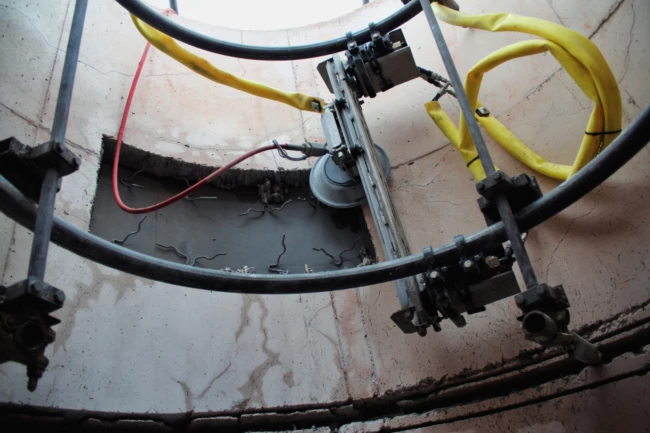
Rentajet operates a full range of refractory removal services configured to the vessel, the lining type and the access constraints on site.
Remote-controlled hydrodemolition rigs mounted on scaffold frames or track systems inside the vessel. The operator works from outside the confined space, controlling cut depth and traverse to remove damaged lining while preserving sound material.
Operator-controlled lance work for restricted-access areas, awkward geometry and small patch zones where rig deployment is not practical. Used as a complement to robotic refractory removal on most large jobs.
Specialist UHP refractory removal from catalyst regeneration chambers, FCC reactors, risers, loop seals and process pipework in oil refining. Anchor preservation is critical on these vessels.
Removal from boiler water walls, furnace floors and walls, incinerator chambers and biomass plant combustion zones. Hydrodemolition refractory removal on flue gas lines, ducts and risers of all diameters.
Controlled removal of failed zones only, leaving adjacent sound refractory in place. Non-percussive refractory removal used during turnarounds where a full reline is not justified.
Refractory lining removal services using UHP water jetting change the safety, programme
and cost profile compared with percussive methods.
The steel shell, boiler tubes and surrounding substrate are not subjected to percussive shock.
Y anchors, stud welds and hex mesh remain intact and reusable, removing the cost of anchor replacement before reline.
Operators control the rig from outside the vessel and crews work normal shifts without rotation for vibration limits.
Remote operation reduces confined space entry to set-up and breakdown only.
UHP removal typically completes lining strip-out up to 10 times faster, shortening turnaround duration on the critical path.
No secondary grinding or surface preparation required before new refractory is installed.
Jackhammers and pneumatic breakers remain the default on sites without specialist water jetting capability. Refractory lining removal services by UHP water jetting carry a higher equipment day rate but pay back through programme compression, anchor preservation and immediate reline readiness.
| Factor | UHP Water Jetting | Jackhammers / Pneumatic Breakers |
|---|---|---|
| Structural vibration | None | High, risks substrate micro-cracking |
| Anchor and hex mesh condition | Preserved intact | Frequently deformed or damaged |
| HAVS risk to operator | None, remote operation | High, shift rotation required |
| Confined space entry | Set-up and breakdown only | Full duration of work |
| Removal speed | Up to 10x faster on bulk strip-out | Slow, labour-intensive |
| Noise and dust | Low, no airborne dust | High noise, significant dust |
| Spark and heat risk | None, safe in ATEX zones | Spark risk, hot work permits required |
| Reline readiness | Immediate, profiled clean surface | Secondary preparation usually needed |
Refractory lining removal services are specified wherever industrial process equipment is exposed to sustained high temperature, chemical attack or abrasive material flow.
UHP refractory removal from FCC units, catalyst regeneration chambers, sulphur recovery units, process heaters and reformer furnaces at refineries and chemical plants. Anchor preservation and substrate protection are mandatory in this sector.
Robotic refractory removal from industrial boiler water walls, furnace floors, biomass combustion chambers, incinerator linings and ducting. Energy-from-Waste plants operate with tight outage windows where speed of removal is critical.
Refractory removal from rotary kilns, induction furnaces, ladles, reheat furnaces and process vessels. Non-percussive refractory removal extends the service life of partially failed linings between major shutdowns.

Rentajet delivers refractory lining removal services to UK industrial operators across the sectors most reliant on high-temperature process equipment.
Refinery turnarounds, FCC overhauls, sulphur recovery and process heater relines. ATEX-aware methodology with spark-free removal.
Boiler, furnace and incinerator lining removal on coal, gas, biomass and Energy-from-Waste plants during planned outages.
Refractory removal from end-of-life process vessels, kilns and combustion plant ahead of cutting and dismantling.
Reactor and process vessel relines, kiln and dryer linings, with controlled removal that preserves surrounding plant.
Hydrodemolition refractory removal from incinerators, boilers and process plant on vessels, FPSOs and offshore installations.
Cement kilns, lime kilns, foundry furnaces and refractory-lined pipework in heavy manufacturing.
Rentajet has been delivering water jetting services to UK heavy industry since 1984.
Refractory lining removal services sit inside a wider capability that includes hydrodemolition, abrasive water jet cold cutting, tank and vessel cleaning and pipeline cleaning, so refractory teams arrive with the full scope of supporting jetting services on the same mobilisation.
• Forty years of UHP water jetting experience: established 1984, delivery across UK
refineries, power stations and process plants.
• Remote-operated robotic and handheld capability: configured to the vessel, the
lining type and the access constraints on site.
• ISO 9001, ISO 14001 and ISO 45001 registered: full Water Jetting Association
membership and adherence to the WJA Code of Practice.
• Engineered solutions for constrained access: bespoke scaffold-mounted track
systems and confined space methodologies for difficult vessels.
• UK-wide mobilisation: Romsey HQ with London and Manchester support, and
overseas capability on project work.
The result is a contractor that procurement and HSE leads can specify with confidence on shutdowns where programme, anchor condition and operator exposure all need to be controlled at once.
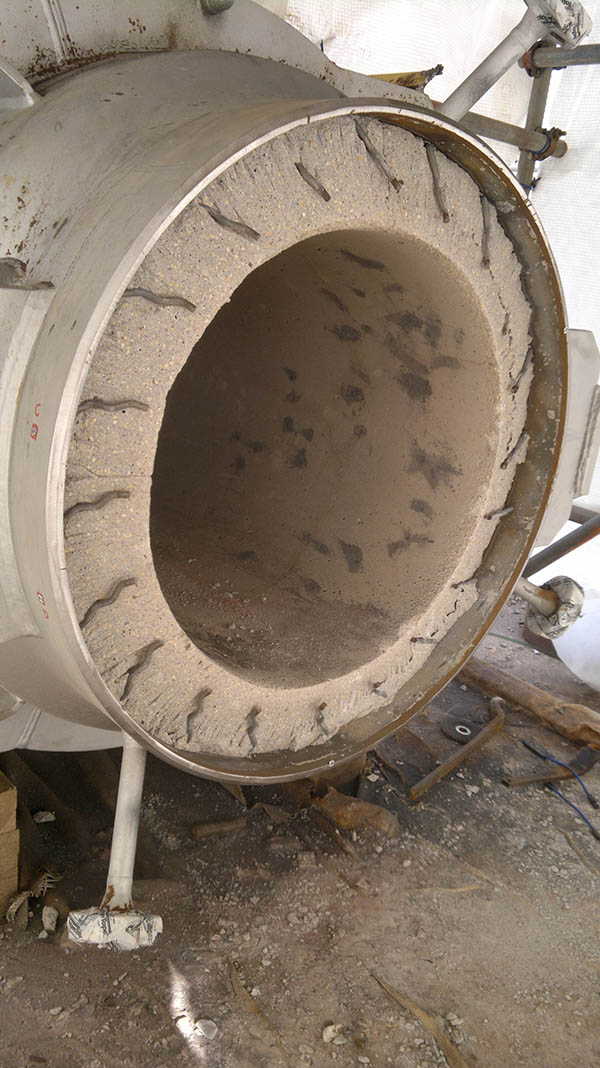
Rentajet follows a five-step process on every refractory removal mobilisation.
We survey the vessel, the lining specification, the anchor type and the access constraints. Method statement and risk assessment produced covering confined space, working at height and WJA Code of Practice.
Rigs, pumps, hoses and scaffold or track mounting mobilised to site. Pump units run at up to 2,800 bar.
The hydrodemolition rig is installed inside the vessel on a scaffold ring, track frame or bespoke mount. Cut depth, traverse speed and nozzle configuration set to the lining specification and signed off before water is applied.
The operator controls the rig remotely from outside the confined space. Lining is stripped to the specified depth, stopping at sound substrate. Non-percussive refractory removal throughout.
Substrate washed down, anchors inspected and confirmed intact, vessel signed off as reline-ready. Photographic record and removal report issued.
UHP refractory removal carries a higher equipment day rate than jackhammering but typically delivers a lower total project cost through programme compression and preserved anchors. Contact us for a project-specific quotation.
Service life varies from a few years on hard-duty FCC linings to a decade or more on lighter-duty boiler linings. Removal is specified when inspection identifies spalling, cracking, hot spots or measurable thinning.
No. The rig is set to cut to the depth of the lining only. Y anchors, hex mesh and stud welds are preserved intact. Non-percussive refractory removal is a primary reason UHP removal is specified over percussive methods.
On bulk strip-out, UHP refractory removal is typically up to ten times faster than hand-tool jackhammering and runs without HAVS shift rotation.
Yes. Robotic refractory removal produces no sparks, no heat and no airborne dust, which simplifies permit-to-work coordination and allows adjacent work to continue without disruption.