
Rentajet provides specialist abrasive water jet cold cutting services for industrial sites across the UK where heat and sparks are not an option. Using ultra-high-pressure water mixed with a fine mineral abrasive, our on-site teams deliver clean, accurate cold cutting on steel, pipework, tanks and vessels in live, hazardous and confined environments. Whether you operate a petrochemical refinery or an offshore decommissioning project, our abrasive water jet cutting service removes ignition risk while keeping operators at a safe distance from the cutting nozzle.
As specialist cold cutting contractors, we deploy engineered cutting carriers and bespoke interfaces for non-standard cuts, combining ATEX cold cutting capability with underwater and subsea cutting under one contractor. Rentajet is mobilised nationwide, with Romsey, London and Manchester coverage and a direct response service for turnaround and decommissioning programmes.
In petrochemical, oil and gas, offshore and decommissioning environments, the cutting method you choose decides whether the job can run at all. Flame cutting, plasma and grinding all generate heat, sparks or both, which means hot work permits, gas-freeing, intrusive isolation regimes and in many cases a complete shutdown of adjacent operations before the first cut is made.
Abrasive water jet cold cutting removes that constraint. Ultra-high-pressure water entrained with a small volume of inert natural garnet abrasive cuts through steel, titanium, composites and clad sections without raising metal temperature, without a heat-affected zone and without producing sparks. The rig is operated remotely from outside the cutting envelope, and the wastewater is normally compatible with site drainage.
That is what gets water jet cutting specified on live tanks, gasometers, FPSO topsides and turnaround critical-path cuts where any other method would stop the job.
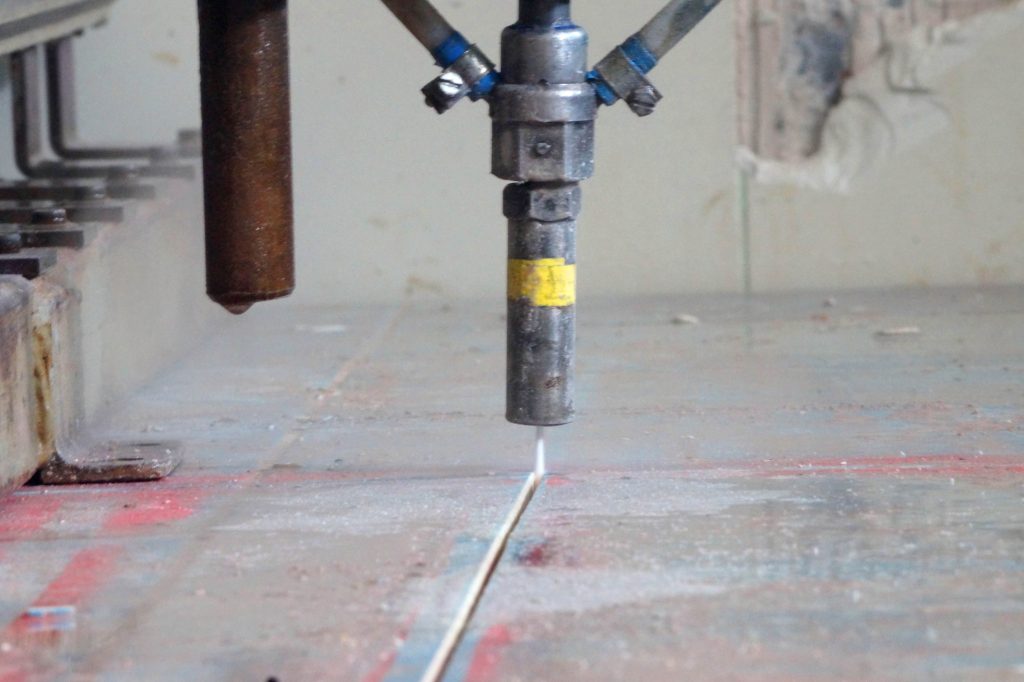
Rentajet operates a full range of abrasive water jet cutting services configured to the cut, the material and the site classification.
Cuts to pipework of almost any diameter and wall thickness, including clad and lined pipe. Nozzles are angled to produce the weld prep in the same operation, removing a separate machining step. Includes spark-free cutting in classified zones.
Sectioning of live and decommissioned tanks, pressure vessels and tank floors into manway-sized plates. Used where leaked or residual product makes hot cutting unsafe.
Controlled access cuts and full decommissioning cuts into gasometers and gas storage vessels for venting, internal inspection or dismantling, without ignition risk.
Internal abrasive water jet cutting of tubular piles, monopiles, conductors and casings below bed level, without divers in the water. Suitable for wind turbine monopile decommissioning and well head severance.
Engineered, hydraulically driven cutting carriers and bespoke interfaces designed to the geometry of the specific cut. Used on non-standard cuts where off-the-shelf tooling is not viable.
Abrasive water jet cold cutting changes the safety, programme and permit profile of steel cutting compared with hot work methods.
Cuts safely in ATEX zones and on live tanks containing residual product or gas, with zero ignition risk.
Removes the gas-freeing and isolation regime that hot cutting imposes on the surrounding plant.
No metallurgical change to the cut edge, which matters on titanium, clad pipe and pressure-rated components.
Rigs are operated from a safe distance from the nozzle, removing personnel from the line of the jet.
Steel, stainless, titanium, composites and clad sections, including thick-wall pressure vessels and monopiles.
Angled nozzles produce the bevel during cutting, eliminating a downstream machining operation.
Hot cutting methods such as oxy-fuel, plasma and grinding remain the default outside hazardous zones. Inside ATEX cold cutting areas or on live tanks, they require gas-freeing, hot work permits and adjacent isolations that often add days to the programme. Abrasive water jet cold cutting carries a higher equipment day rate but removes the permit and isolation overhead, which on most hazardous-zone scopes makes it the lower total cost route.
| Factor | Abrasive Water Jet Cold Cutting | Oxy-Fuel / Plasma / Grinding |
|---|---|---|
| Spark and ignition risk | None, safe in ATEX zones | High, hot work permit required |
| Heat-affected zone | None, cold cut | Significant, alters parent metal |
| Suitability on live tanks | Yes, no gas-freeing required | No, gas-freeing and isolation needed |
| Weld preparation | Produced in the same cut | Separate machining operation |
| Material range | Steel, titanium, composites, clad | Limited on titanium and composites |
| Operator position | Remote, outside cut envelope | At the cut, in the hazard zone |
| Permit overhead | None for hot work | Hot work permit and standby required |
| Environmental output | Water plus inert garnet | Fume, slag, dust |
Abrasive water jet cold cutting is specified wherever heat, sparks or hot work permits make conventional cutting unworkable.
Cuts on live tanks, vessels and pipework inside refineries, terminals and chemical plants. Includes tank floor sectioning, FCC and process pipework cuts during turnarounds, and gasometer access cuts.
Subsea pile and monopile cold cutting below bed level, well head and conductor severance, and topsides cuts on FPSOs and platforms where hot work is restricted. Used on offshore wind decommissioning and oil and gas plug-and-abandonment.
Sectioning of redundant process plant, storage tanks, gasometers and structural steel on end-of-life industrial sites. Spark-free cutting allows controlled removal in atmospheres where flame cutting would not be permitted.

Rentajet delivers abrasive water jet cold cutting to UK operators across the sectors where hot work is restricted, controlled or impossible.
Refinery turnarounds, live tank cuts, gasometer access and FCC pipework sectioning. Refinery-ready equipment with Chalwyn valves, spark arrestors and earth connections.
Subsea pile cutting, monopile decommissioning, FPSO topsides cuts and shipyard cold cutting where hot work permits cannot be issued.
End-of-life process plant, gas works, oil terminals and storage tank decommissioning. Section cuts engineered to manway and access constraints.
Cutting and sectioning of plant structures during decommissioning on power generation and utilities sites.
Water jet cutting of structural steel and heavy components on civil and manufacturing projects where controlled, heat-free cutting is required.
Precision cutting on infrastructure assets where heat, sparks or fume would create safety or operational risk.
Rentajet follows a five-step process on every cold cutting mobilisation.
We survey the structure, the material, the access and the site classification, and confirm the cut geometry, rig type and waste-water management plan. Method statement and risk assessment produced to WJA Code of Practice and ATEX compliance.
UHP pumps, abrasive delivery system and cutting rig mobilised to site. Pump units run at up to 2,800 bar.
Cutting carrier fitted to the structure and aligned to the cut geometry. Pressure, abrasive feed and traverse speed confirmed before cutting starts.
The rig cuts to the specified geometry while spent abrasive slurry and debris are contained at source. Operators control the process remotely from outside the cutting envelope.
Completed cut inspected against the specification, weld prep geometry confirmed, photographic record issued and cut section handled to the agreed disposal or reinstallation plan.
Abrasive water jet cold cutting carries a higher equipment day rate than hot cutting but removes the gas-freeing, permit and isolation overhead that hot work adds to hazardous-zone scopes. Contact us for a project-specific quotation.
Steel, stainless steel, titanium, aluminium, composites, clad materials, concrete and ceramics. Abrasive water jet cutting handles almost any wall thickness given sufficient pressure and abrasive volume.
Yes. ATEX cold cutting produces no sparks and no heat, so it can be used in ATEX-classified zones and on live tanks containing residual product or gas, without hot work permits or gas-freeing.
Yes. Cutting nozzles are angled to produce the bevel in the same operation, eliminating a separate downstream machining step and shortening the programme.
Spent abrasive slurry and cut debris are contained at source. The waste stream is water and inert natural garnet, with no chemical hazard, and is typically compatible with site drainage or can be collected for off-site disposal.